How Pet Loss Support Aids Grieving Owners
Losing a pet often feels like losing a family member. The grief that follows can be deep, complicated, and frequently minimized by others. This guide describes how pet loss support groups and a structured grief-recovery program help owners process attachment, reduce shame, and begin rebuilding everyday life. You’ll learn why pet grief is different, the clear benefits of group-based bereavement work, how both virtual and in-person formats improve access, and why storytelling and memorials matter for healing. We also walk through how our action-focused 6-session recovery program blends holistic modalities to support emotional completion and lessen guilt. Sections cover anticipatory grief, children’s experiences, and practical next steps for booking and pricing so you don’t have to navigate this alone. By the end you’ll have concrete coping practices, criteria for evaluating groups, and resources to find the right format for you or your family.
Why Pet Loss Grief Feels Different — and How It Shows Up
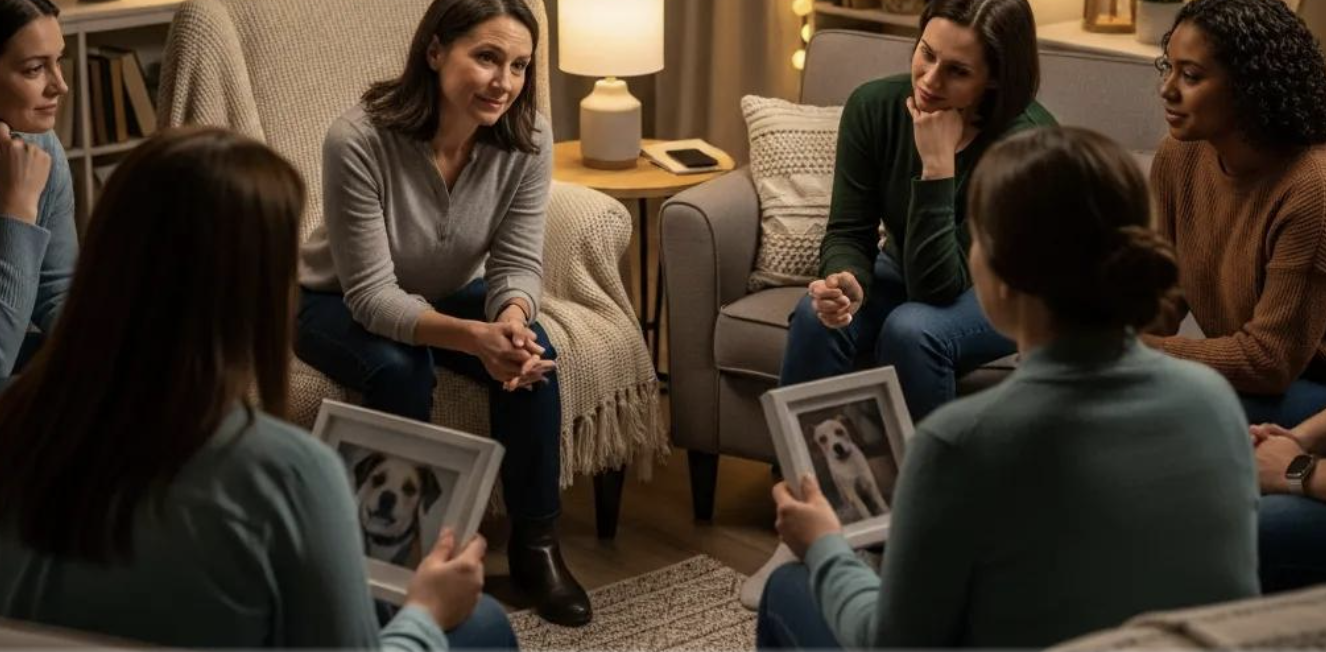
Grief after pet loss is shaped by the daily caregiving, routines, and companionship that define the human-animal bond. When a pet dies, people often face sudden role loss, painful changes in identity, and a disruption of daily rhythms—all of which fuel intense attachment wounds. Social minimization or stigma can deepen isolation and slow recovery. Appreciating these differences explains why peer-based support and specialized bereavement groups are especially helpful for pet owners. The sections below explore what distinguishes pet grief, typical emotional patterns, and signs that it’s time to seek group or professional support.
What Makes Pet Grief Different From Other Losses?
Pet grief blends practical intimacy with social and legal ambiguity: pets may not be recognized as family legally, yet owners perform intimate caregiving tasks that create real interdependence. That mismatch produces distinctive role loss—no longer being the person who feeds, walks, or medicates your companion—and often removes public rituals that acknowledge the loss. Stigma or minimization from friends, workplaces, or institutions can increase isolation and raise the risk of complicated grief. Seeing these dynamics clearly helps owners find resources that validate the human-animal bond and offer rituals or narrative closure.
How Do Emotions and Grief Stages Usually Appear After Pet Loss?
People commonly experience shock, disbelief, deep sadness, anger, guilt, and a persistent longing that can disrupt sleep and daily functioning. Much of this mirrors classic grief stages, but practical routine loss and decision-related guilt (especially around euthanasia) are particularly common and can fuel self-blame. Timelines vary: some adapt within weeks, while others face prolonged or complicated grief that benefits from group or clinical support. If intrusive ruminations, major functional impairment, or persistent avoidance appear, facilitated peer groups and targeted interventions are recommended to reduce isolation and support healthy processing.
Key Benefits of Joining a Pet Loss Support Group
Pet loss groups offer emotional validation, shared understanding, practical coping tools, and a community that normalizes grief—mechanisms that reduce shame and support adaptive mourning. Hearing others’ stories and receiving guided feedback produces measurable reductions in isolation and self-blame. The short table below connects primary benefits to how they help and gives example practices or modalities used by groups. Afterward we describe how structured programs turn these benefits into action-oriented sessions.
Different group benefits map to concrete mechanisms and practices that support grieving owners.
Benefit
How It Helps
Example Practice or Modality
Emotional validation
Normalizes feelings and lessens shame
Peer sharing and compassionate witnessing
Coping skill acquisition
Provides tools to manage distress
Breathwork and grounding exercises
Community and connection
Replaces the caregiving routine with social support
Regular check-ins and buddy systems
Meaning-making & memorialization
Supports narrative closure and identity repair
Storytelling, ceremonies, and keepsakes
This comparison shows how group benefits translate into practical facilitator-led practices that support grief recovery. Next, we explain how validation and shared understanding happen in group settings.
How Support Groups Create Emotional Validation and Shared Understanding
Well-run support groups act as corrective social spaces where witnessing and empathy validate intense emotional reactions—especially important when wider networks minimize the loss. Facilitators establish norms—confidentiality, nonjudgmental listening, and turn-taking—that keep sharing safe and reduce retraumatization. Hearing similar stories helps members find language that reframes shameful thoughts, and collective rituals provide public recognition of the loss. These dynamics create readiness for learning coping skills, which we outline next.
Practical Coping Strategies Taught in Pet Loss Groups
Groups blend somatic and cognitive tools with emotional processing. Typical techniques include structured rituals for memorializing, journaling prompts to reframe guilt, breathing and grounding practices for acute distress, and guided imagery to support emotional completion. Facilitators often introduce conscious connected breathwork to calm the nervous system and cognitive reframing to gently challenge catastrophic or self-blaming narratives. Practicing these skills with peer feedback builds resilience and reduces the frequency and intensity of overwhelming grief episodes.
Virtual, In-Person, and Hybrid Groups: How Each Format Supports Healing
Virtual and in-person formats offer different access advantages and therapeutic dynamics; both can be effective when facilitated skillfully. Virtual groups expand geographic reach, offer scheduling flexibility, and allow for anonymity, increasing access to specialized facilitators. In-person groups bring embodied presence, nonverbal empathy, and local resource connections that help rebuild community. The table below highlights each format’s strengths to help you choose what fits your needs.
Format
Advantage
Best Use Case
Virtual
Flexible scheduling, anonymity, specialist access
Remote participants or those with limited mobility
In-person
Embodied presence and stronger local bonds
Wanting tactile support and local community connection
Hybrid
Combines reach with occasional in-person connection
Long-term groups that meet both online and locally
This comparison helps you match format to need. Below we highlight virtual advantages and offer practical tips for participation.
Advantages of Virtual Pet Loss Support Groups
Virtual groups remove geographic barriers, making it possible to work with specialized grief facilitators and modality-specific programs no matter where you live. The privacy of joining from home can reduce stigma and make it easier to seek help early. Practical tips: test your audio/video ahead of time, create a quiet private space, and set personal boundaries around session length to protect emotional safety. These steps help you get the most from online grief work and prepare for potential in-person follow-up when helpful.
Where San Diego Owners Can Find In-Person Pet Loss Support
San Diego owners can find in-person grief support through community centers, veterinary referrals, and specialized providers serving neighborhoods such as La Jolla and Pacific Beach. When choosing an in-person group, look at facilitator credentials, group size limits, confidentiality practices, and whether the program includes evidence-based or adjunct holistic modalities. Local groups also link members to nearby bereavement resources and memorial services that support ritual-making. If you want both local presence and schedule flexibility, consider hybrid providers or compare neighborhood listings and virtual options.
How The Guides Holistic Therapies’ 6-Session Pet Loss Recovery Program Supports Healing
A focused, action-oriented recovery program sequences evidence-informed practices across sessions to promote emotional completion, reduce guilt, and teach coping skills—rather than relying only on open-ended processing. The Guides Holistic Therapies offers a 6-session Pet Loss Grief Recovery Program that blends holistic modalities—Reiki Energy Healing, Sound Therapy, Conscious Connected Breathwork, and Clinical Hypnotherapy—with facilitated group processes to support somatic regulation and narrative integration. The program is available in person in San Diego (La Jolla / Pacific Beach) and online, making it accessible across locations. Pricing is reported at $160 per session when enrolled in the 6-session program and $200 for single sessions; HSA/FSA and superbills are available as noted for billing transparency. Below is a session-by-session outline of goals and techniques.
Session Number
Focus / Goal
Modality / Techniques Used
1
Stabilization and assessment
Intake, safety planning, grounding exercises
2
Emotional processing
Conscious connected breathwork and guided sharing
3
Somatic release
Reiki Energy Healing and sound therapy for regulation
4
Narrative integration
Story prompts, journaling, and hypnotherapy for memory reframing
5
Ritual & memorial planning
Co-created ceremonies and keepsake creation
6
Consolidation & relapse prevention
Skills review, community linkages, and next-step planning
This structure pairs clear goals with modalities and techniques to form a practical plan for processing grief and moving toward resolution.
Program Structure and Therapeutic Approach
The program follows an assessment-to-consolidation arc: safety and stabilization, emotional and somatic processing, narrative work, memorial creation, and relapse prevention. Sequencing sessions this way reduces retraumatization risk by combining experiential somatic work with cognitive reframing and guided group reflection. Action-focused elements—guided exercises, take-home practices, and tangible memorial tasks—help translate insight into daily routines and ease persistent guilt. By the final session participants leave with a plan for ongoing community connection and self-care strategies to support longer-term adaptation.
How Holistic Modalities Like Reiki and Breathwork Support Grief Recovery
Holistic modalities address the body–mind interface: conscious connected breathwork helps regulate the autonomic nervous system so intense emotions become more tolerable; Reiki supports energetic balance and a calmer internal state; sound therapy uses vibration to shift affective tone and access stored emotion; and clinical hypnotherapy can assist in reframing regret-filled memories. These approaches work alongside group processing to create physiological safety that allows cognitive and narrative work to proceed more effectively. Together, an integrated approach can speed emotional completion and reduce overwhelm.
How Storytelling and Memorials Support the Grieving Process
Sharing stories and creating memorials turns fragmented feelings into coherent narratives, helps repair identity, and honors the relationship you had with your pet. Storytelling in groups offers witness, co-created meaning, and corrective feedback that reduces shame and highlights adaptive themes within painful memories. Memorialization provides rituals often missing for pet loss, giving symbolic continuity and tangible anchors for grief work. The sections below explain storytelling’s therapeutic role and list practical memorial ideas groups commonly support.
Why Storytelling Matters in Pet Loss Groups
Storytelling is a core meaning-making process: naming memories organizes emotion, contextualizes decisions, and helps re-author the relationship as one of remembrance rather than ongoing caregiving. In groups, narrative exchange builds empathy and offers new language to reframe guilt as understandable given the circumstances. Facilitated prompts and safe turn-taking protect against retraumatization while preserving honesty. Collective reflection often uncovers shared themes that normalize intense feelings and naturally lead into memorial planning.
Practical Ways to Memorialize a Beloved Pet
Memorials provide intentional recognition that helps you shift from daily caregiving to lasting remembrance. Ideas include creating a memory box with photos and keepsakes, planting a tree or garden, holding a small ceremony with friends or group members, making art or writing a letter to your pet, or building a digital memorial. Groups can support co-created rituals—shared candle-lighting, group readings, or collaborative playlists—to offer social validation and shared closure. These activities move private grief into witnessed remembrance, strengthening bonds and easing isolation.
Memorial activities combine personal expression with communal recognition.
Group-led ceremonies provide structure and reduce the planning burden.
Creative memorials (art projects, plantings, keepsakes) create tangible reminders.
Groups that help with memorial work support the transition to ongoing remembrance and encourage meaningful follow-up practices.
Resources for Special Pet Loss Situations
Certain situations—anticipatory grief during illness, children’s grief, and complex end-of-life decisions—need tailored support that blends emotional preparation with practical guidance. Support groups and structured programs can offer decision-focused exercises, age-appropriate materials for families, and facilitated conversations that reduce later regret. Providers may also offer transparent booking and pricing to reduce administrative stress during a vulnerable time. The sections below unpack anticipatory grief support, resources for children, and how to book a consultation and understand reported pricing.
How Groups Support Anticipatory Grief and End-of-Life Decisions
Anticipatory grief work creates space to discuss prognosis, values, and care preferences before a crisis, which reduces the chance of rushed or regretful decisions. Facilitators use structured exercises—values clarification, guided conversations, and role-play—to prepare owners emotionally and ethically for likely outcomes. Peer perspectives illuminate common practical dilemmas, and referral networks can connect families with veterinary hospice or specialized counseling when appropriate. Preparing together helps turn uncertainty into actionable plans and reduces post-loss guilt through pre-loss meaning-making.
Support Options for Children Experiencing Pet Loss
Children respond best to honest, age-appropriate explanations, activities that externalize feelings, and predictable routines that restore a sense of safety. Effective approaches include simple concrete language about death, storytelling prompts, memory boxes, drawing, and guided ceremonies that let children express themselves without overwhelming them. Family-based group options or referrals to child-focused bereavement services help parents model healthy mourning and provide consistent follow-up. Treating grief as a shared family process helps children integrate the loss while preserving attachment security.
How to Book a Consultation and Understand Pricing
When seeking professional help, prioritize transparent booking, clear pricing, and billing options that reduce friction during distress. As reported, The Guides Holistic Therapies lists the 6-session Pet Loss Grief Recovery Program at $160 per session when enrolled in the full program, and single sessions at $200; HSA/FSA and superbills are available to support insurance-friendly billing. To begin, request an intake or consultation to assess fit, discuss modality preferences, and choose virtual or in-person scheduling with the facilitator. Clear pricing and billing options remove administrative barriers so you can focus on the work of healing.
Review program structure and modality integration before you schedule.
Ask about virtual versus in-person formats to match accessibility needs.
Confirm billing options (HSA/FSA/superbill availability) so payment is clear.
These steps make booking smoother and ensure the program aligns with both clinical and logistical needs.
Conclusion
Joining a pet loss support group can bring profound validation, practical coping tools, and a caring community to ease the grieving process. Through shared stories and structured practices, owners can move from isolation toward healing and connection. If you’re ready, consider our 6-session Pet Loss Grief Recovery Program—designed to help you honor your beloved pet while building resilience and emotional well-being.